Follow Barack Obama prior and during his tenure as the 44th President of the United States. Read about my personal observations along with every day facts as they happen. This blog will only submit factual information about the first black President, now in his 2nd term of office.
BARACK OBAMA MEMORIBILIA available right HERE at www.obamaitems.info

BARACK OBAMA IN THE WHITEHOUSE

Send E-mail to the Editor at: obamainthewhitehouse@mail.com
Click on the GOOGLE TRANSLATE BUTTON BELOW AND SELECT YOUR LANGUAGE

Search This Blog

Showing posts with label successor to Fidel Castro. Show all posts

Poll: Three-quarters favor relations with Cuba

Friday, April 10, 2009


(CNN) -- A new poll shows that two-thirds of Americans surveyed think the U.S. should lift its travel ban on Cuba, and three-quarters think the U.S. should end its five-decade estrangement with the country.
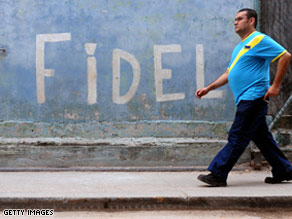
Fidel Castro led Cuba's communist revolution in 1959 and recently handed over power to his brother Raul.
Fidel Castro led Cuba's communist revolution in
1959 and recently handed over power to his
brother Raul.

According to the CNN/Opinion Research Corp. poll conducted April 3 to 5, 64 percent of the 1,023 Americans surveyed by telephone thought the U.S. government should allow citizens to travel to Cuba.
And 71 percent of those polled said that the U.S. should reestablish diplomatic relations with Cuba, while 27 percent opposed such a move.
Both questions had a sampling error of plus or minus 3 percentage points.
The Obama administration has signaled that new rules on family travel and remittances to Cuba may be announced before President Obama goes to the Summit of the Americas on April 17.
A group of senators and other supporters unveiled a bill March 31 to lift the 47-year-old travel ban to Cuba.
"I think that we finally reached a new watermark here on this issue," said Sen. Byron Dorgan, D-North Dakota, one of the bill's sponsors.
Sen. Richard Lugar, R-Indiana, another sponsor of the bill, issued a draft report in February that said it was time to reconsider the economic sanctions. Lugar is the ranking Republican on the Senate Foreign Relations Committee. Interactive: Learn more about Cuba »
"Republicans as well as Democrats favor reestablishing diplomatic relations with Cuba," CNN polling director Keating Holland said. "On the issue of lifting travel restrictions, Republicans are evenly divided, while independents and Democrats support the change."
A delegation from the Congressional Black Caucus traveled to Cuba earlier this week to find out if Cuba was interested in resuming relations with the U.S., said Rep. Barbara Lee, D-California, a member of the delegation.
"We have to remember that every country in Latin America, 15 countries, have normal relations with Cuba," Lee said. "We're the country which is isolated." Video Watch Lee discuss her visit to Cuba »
Lee said that Cuba has no preconditions on resuming relations.
The trip prompted a pair of Republican congressmen to rip the Black Caucus members for ignoring Cuba's "myriad gross human rights abuses," saying the trip to the island nation ignored the plight of political prisoners under the Castro regime.
Reps. Chris Smith of New Jersey and Frank Wolf of Virginia also urged the Obama administration to refrain from easing trade embargo or travel restrictions until the Cuban government releases all "prisoners of conscience," shows greater respect for freedom of religion and speech, and holds "free and fair" elections.
Cuban-American members of Congress, regardless of party affiliation, have voiced outrage over the easing of relations.
Florida Republican Sen. Mel Martinez, who was born in Cuba, doesn't want to see changes to the embargo.
"Having tourists on Cuban beaches is not going to achieve democratic change in Cuba," Martinez has said.
New Jersey Sen. Robert Menendez, a Democrat and Cuban-American, said in a recent speech that the Cuban government is "pure and simple a brutal dictatorship. ... The average Cuban lives on an income of less than a dollar a day."
Obama has said he is in favor of changing the relationship with Cuba. The $410 billion budget Obama signed in March makes it easier for Cuban-Americans to travel to Cuba and to send money to family members on the island. It could also allow the sale of agricultural and pharmaceutical products to Cuba.
Three provisions attached to the omnibus spending bill loosened restrictions enacted by former President Bush after he came to office in 2001.
advertisement
U.S. citizens are allowed to visit Cuba, but must apply for special licenses to do so. Though it is illegal, some citizens travel to a third country like Mexico or Canada and then into Cuba.
Fidel Castro led the 1959 revolution that overthrew Cuba's Batista dictatorship. The United States broke diplomatic ties with the nation in 1961. The next year, the U.S. government instituted a trade embargo. Both policies remain in effect.  

Read more...

Bill to OK travel to Cuba to be unveiled

Tuesday, March 31, 2009

WASHINGTON (CNN) -- A group of senators and other supporters will unveil a bill Tuesday to lift the 47-year-old travel ban to Cuba.

Senators who support lifting travel restrictions to Cuba say it will help improve U.S. relations with the country.
Proponents of lifting the ban have been trying for years but lacked the votes in Congress or a president who supported the measure. Now, with Democrats holding majorities in both houses of Congress and controlling the White House, supporters said they believe their chance is at hand.
Senators who support lifting travel restrictions to Cuba say it will help improve U.S. relations with the country. "Seems to me when you have a policy that has failed for five decades, you ought to take a look at it again and see if you should modify it," said Sen. Byron Dorgan, D-North Dakota, one of the bill's sponsors. "We allow Americans travel to Vietnam and China, both communist countries."
The United States broke diplomatic relations with Cuba in 1961, two years after Fidel Castro assumed power. In 1962, the United States established a trade embargo. Both policies remain in place.
In addition, the United States has imposed other restrictions over the years, most recently under President Bush.
Sen. Richard Lugar, R-Indiana, another sponsor of the bill, issued a draft report in February that said it's time to reconsider the U.S. economic sanctions. Lugar is the ranking Republican on the Senate Foreign Relations Committee.
Video Watch why some senators want to lift the ban »
"After 47 years ... the unilateral embargo on Cuba has failed to achieve its stated purpose of 'bringing democracy to the Cuban people,' " Lugar wrote in a letter accompanying the 21-page draft report.
"The current U.S. policy has many passionate defenders, and their criticism of the Castro regime is justified. Nevertheless, we must recognize the ineffectiveness of our current policy and deal with the Cuban regime in a way that enhances U.S. interests."
Sen. Chris Dodd, D-Connecticut, also supports lifting the travel ban.
He and others said they see an opportunity for improved relations because the ailing Castro ceded power last year to his younger brother, Raul, seen as more pragmatic and less idealistic and doctrinaire.
Cuban-Americans mostly have opposed any shift in policy, but that view may be changing. Many second- and third-generation Cuban-Americans have views that are more lenient than those of elder Cubans who came to the United States in the 1960s.
And some Cuban-Americans have a vested interest in lifting the travel ban. Tessie Aral, owner of a Miami, Florida, travel agency that specializes in trips to Cuba, is one of them.
"I think a lot of Americans are going to want to travel to Cuba because it's been the forbidden fruit for so long," Aral said. "For our country to tell us which country we can travel to, I think that's just archaic."
Daniel Erikson, author of "The Cuba Wars," said there's one problem with lifting the travel ban -- the trade embargo, which stops U.S. companies from doing business in Cuba.
"So you would have American tourists traveling to Cuba driving around on Chinese buses, staying at Spanish hotels, eating Canadian food," Erikson said, adding, "The only McDonald's I've ever seen in Cuba is at the military base at Guantanamo Bay."
President Obama has indicated he favors changes in U.S.-Cuba policy but has not offered details. Cracks in the policy have started to develop though.
The $410 billion budget Obama signed this month makes it easier for Cuban-Americans to travel to Cuba and to send money to family members on the island. It also could facilitate the sale of agricultural and pharmaceutical products to Cuba.
Three provisions attached to the omnibus spending bill loosened restrictions enacted by Bush after he came to office in 2001.
Analysts have said they saw the move as a way for the Obama administration to start thawing relations with Cuba before the Fifth Summit of the Americas brings together the U.S. president and 33 other leaders from the Western Hemisphere in mid-April in Trinidad and Tobago.
Other groups also are calling for a new direction.
The nonprofit Brookings Institution said in a recent report that the administration should lift travel restrictions and adopt other measures to start normalizing relations. A group of 19 academics, opinion leaders and diplomats met for 18 months to formulate 33 short-, medium- and long-term initiatives compiled in a report called "U.S. Policy Toward a Cuba in Transition."
But any changes would have to get past Cuban-Americans in Congress, such as Sen. Robert Menendez, D-New Jersey.
advertisement
"The government is pure and simple a brutal dictatorship," Menendez said in a recent speech. "The average Cuban lives on an income of less than a dollar a day."
Nonetheless, supporters said they believe they can get the bill to the White House for Obama to sign.
CNN's Arthur Brice contributed to this report.
All About CubaFidel CastroBarack Obama

Read more...

Obama's stand on Cuba

Sunday, December 28, 2008

During the past 8 years, President Bush tightened his grip against Cuba, not alowing people to visit freely or even to be able to send money to Cuba. But now it appears that what Barack Obama may do is to allow Cuban-Americans to visit more frequently, along with allowing them to send more money to the island.At the present time, there is a trade and travel embargo, and has been since 1962 in an attempt to bring down Fidel Castro's government. For 50 years now, the only thing proven is that the embargo doesn't work, and is actually counterproductive towards positive results and besides, there is no international support.
Just recently Castro at age 82, has ceded his presidency to his brother Raul Castro, now at age 77. Nothing likely seems forthcoming anytime soon of any fundamental changes in the Cuban government and their policies. According to msnbc.com, 'Obama has promised to lift limits that President George W. Bush tightened on Cuban-Americans wanting to visit and send money to relatives. He also says he's open to a dialogue with Raul Castro — something the Cuban president has indicated he would welcome.'Maybe what Obama might do is to see if Congress could act in eliminating the embargo altogether, which will allow Americans to freely travel to Cuba.This would bring a boost in the economy in Cuba, as visitors would spend their money in Cuba. At the present time, Barack Obama supports the Embargo, but it is almost certain that he will do whatever can be done to help the cause between Cuba and the United States. If he does, then it will be just another bold move by a man who seems to tackle most any problem that comes his way. It is my personal opinion that Obama may outperform President Bush very early in his presidency, which will highlight just how good a President he is, along with how bad President Bush was while in office.

Read more...

  © Free Blogger Templates Columnus by Ourblogtemplates.com 2008

Back to TOP