Follow Barack Obama prior and during his tenure as the 44th President of the United States. Read about my personal observations along with every day facts as they happen. This blog will only submit factual information about the first black President, now in his 2nd term of office.
BARACK OBAMA MEMORIBILIA available right HERE at www.obamaitems.info

BARACK OBAMA IN THE WHITEHOUSE

Send E-mail to the Editor at: obamainthewhitehouse@mail.com
Click on the GOOGLE TRANSLATE BUTTON BELOW AND SELECT YOUR LANGUAGE

Search This Blog

Showing posts with label Al Qaeda. Show all posts

Unannounced Trip to Afghanistan - WHY?

Sunday, March 28, 2010

(CNN) -- President Obama made an unannounced trip to Afghanistan on Sunday.

The president left his Camp David, Maryland, retreat for the trip and flew to Afghanistan on Air Force One, landing at Bagram Air Base at 7:24 p.m. (around 11 a.m. ET).

Obama then flew on a helicopter to the Presidential Palace for a meeting with Afghanistan's president, Hamid Karzai.

------------------------------------------------------------------------------------------

What may be his reasons for going, and why a surprise trip?

Afghanistan, which is an Islamic Republic is located in South-Central Asia, and is borderd by Pakistan in the south and east, Iran in the west, Turkmenistan, Uzbekistan and Tajikistan in the north, and China in the far northeast. It is definitely a place I would not want to be. But to his dislike, President Obama found himself sending more and more troops to the area, and now is the time for him to come and visit the troops. President Obama decided it was important in this moment of time to meet with the Afghanistan president, Hamid Karzai. Going back to December 2009, president Obama supported the deployment of 30,000 additional U.S. troops to Afghanistan which is a strategy to reverse the Taliban's momentum and stabilize the country's government. In the past, there were imminent threats of overthrowing the government by the Taliban, but recently, "al Qaeda has not re-emerged in Afghanistan in the same numbers as before 9/11, but they retain their safe-havens along the border.
With this said, President Obama plans to start removing troops from Afghanistan by July 2011, and most troops should be back home by the end of President Obama's current term, which ends in January 2013.
By arriving in Afghanistan, President Obama whats to restate his intentions with the U.S. presence in the country.

His 3 main objectives are:

1) Deny al Qaeda a safe haven

2) Reverse the Taliban's momentum and deny it the ability to overthrow Afghanistan's government

3) Strengthen Afghanistan's security forces and government

Sending additional troops is a way to achieve these goals. But Afghanistan has a part in it too. The Afghan government leaders must be held accountable for actions concerning corruption, and do what is necessary to try and save lives, along with help securing its own borders with Pakistan. Since Pakistan is very critical in the war against al Qaeda, mainly because the borders are severely infected with these terrorists, and President Obama no doubt is talking with the Afghan President to work a strategy that works on both sides of the border. Nevertheless, each mission has a deadline, and President Obama only sent the troops because he has a plan, to enter, to execute, and to leave in a timely fashion, as to not put our troops in harms way any longer than needed.

President Obama is in Afghanistan today because he wants to refresh his thinking with President Hamid Karzai.

Read more...

U.S. not lined up to defeat al Qaeda, top official warns

Friday, April 10, 2009

By Pam Benson
CNN National Security Producer
WASHINGTON (CNN) -- The nation's chief counterterrorism official says despite a "seriously diminished" threat to the homeland, the U.S. government is still not properly organized to support the "team" effort needed to defeat al Qaeda.
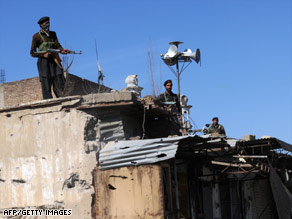
Pakistani soldiers watch area where al Qaeda operates. A top U.S. official says al Qaeda grows stronger there.
Pakistani soldiers watch area where al Qaeda
operates. A top U.S. official says al Qaeda
grows stronger there.
Mike Leiter, the director of the National Counterterrorism Center, said the government has made vast improvements since the terrorist attacks of Sept. 11, 2001, but budgets, plans, programs and personnel are still set up along individual departments and agencies.
"This is a team sport, but the structures are not organized to support the team," explained Leiter.
Leiter discussed the current state of al Qaeda, and future threats, during a conference Thursday at the Aspen Institute, a nonpartisan think tank in Washington.
The threat al Qaeda poses to the United States homeland from its safe haven along the Pakistan-Afghanistan border has "seriously diminished" over the past year, according to Leiter. But in its base region, the local threat from al Qaeda "is probably as bad as we have ever seen."
The recent attack against a police facility in Lahore, Pakistan, was cited by Leiter as an example of how militant groups in the region have aligned themselves with al Qaeda to try and undermine the stability of the weak Pakistani government. Some of those groups have also launched attacks against U.S. and coalition forces operating out of Afghanistan.
The director reiterated the often-stated concern that Pakistan wasn't doing enough to help the situation.
"There are many times the U.S. government wished the Pakistani government -- intelligence and military services -- had the greater willingness and capability to do some of the things we think need to be done," said Leiter.
Leiter attributed the reduced threat to the U.S. homeland to a series of successful actions taken by the United States.
Over the past year, the CIA has launched missile strikes from unmanned planes against suspected terrorists operating out of the ungoverned regions of Pakistan.
According the counterterrorism chief, the ability of al Qaeda leadership to train and deploy crews to attack the U.S. has diminished.
"Al Qaeda and its ability to project threats to Western Europe and the U.S. is much lower than it was last year and lower than it has been for some time," he said, but he warned, "lower does not mean the threat is not alive."
Leiter expressed concerned about the resurgence of al Qaeda in the Arabian peninsula in the past six to 12 months. He cited the increasing number of attacks by terrorists in Yemen and the growing influence of al Qaeda and the Islamist group al Shahab in Somalia.
The Mumbai, India, attacks late last year, where a group of terrorists used more conventional means to attack multiple locations, showed a change of tactics and raised the question of how the terrorist threat might manifest itself in the future. Leiter said the focus has been on suicide bombers, but, "Mumbai reminds us that old-school tactics like AK 47s (rifles) can be effective."
Should the United States continue to refer to the efforts against jihadists as the war against terrorism? That's what the Bush administration called it, but many in the Obama administration have been reluctant to do so.
Leiter said there has been an evolution of understanding about terrorism. Immediately after 9/11, he said, it was impossible to think of this in terms other than a war.
The battle against terrorists in Pakistan and Afghanistan could still be considered a war, but Leiter said the terminology can be counterproductive. He referred to it as a campaign against terror.

Read more...

Obama: Anti-terror plans focus on Pakistan, Afghanistan

Tuesday, March 31, 2009

WASHINGTON (CNN) -- More troops, new legislation, improved troop training and added civilian expertise highlight President Obama's strategy to fight terrorism in Afghanistan and Pakistan.

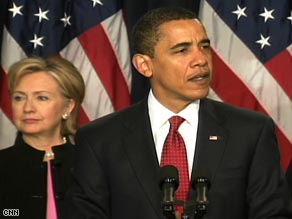
President Obama, here with Hillary Clinton on Friday, calls the situation in Afghanistan "increasingly perilous."
Obama on Friday announced his plan to tackle what he called an "international security challenge of the highest order."
Stressing soberly that "the safety of people around the world is at stake," Obama said the "situation is increasingly perilous" in the region in and around Afghanistan, where the United States has been fighting al Qaeda and the Taliban for more than 7½ years after attacks in New York and at the Pentagon.
"The United States of America did not choose to fight a war in Afghanistan. Nearly 3,000 of our people were killed on September 11, 2001, for doing nothing more than going about their daily lives," said Obama, who has vowed to make Afghanistan the central front in the fight against terrorism.
"So let me be clear: Al Qaeda and its allies -- the terrorists who planned and supported the 9/11 attacks -- are in Pakistan and Afghanistan. Multiple intelligence estimates have warned that al Qaeda is actively planning attacks on the U.S. homeland from its safe haven in Pakistan.
Video Watch how the U.S. will target terrorist safe havens »
"And if the Afghan government falls to the Taliban -- or allows al Qaeda to go unchallenged -- that country will again be a base for terrorists who want to kill as many of our people as they possibly can."
Obama said it is key Americans understand that Pakistan "needs our help" against al Qaeda.
"Al Qaeda and other violent extremists have killed several thousand Pakistanis since 9/11. They have killed many Pakistani soldiers and police. They assassinated [former Pakistani Prime Minister] Benazir Bhutto. They have blown up buildings, derailed foreign investment and threatened the stability of the state. Make no mistake: Al Qaeda and its extremist allies are a cancer that risks killing Pakistan from within."
Video Watch Obama's speech on Afghanistan, Pakistan threats »
Flanked by Secretary of State Hillary Clinton and Defense Secretary Robert Gates, Obama called on Congress to pass a bipartisan bill co-sponsored by Sens. John Kerry, D-Massachusetts, and Richard Lugar, R-Indiana.
The legislation authorizes "$1.5 billion in direct support to the Pakistani people every year over the next five years -- resources that will build schools, roads and hospitals and strengthen Pakistan's democracy," he said.
He also urged Congress to pass legislation that would create opportunity zones in the border region. The goal is to develop the economy and bring hope to places plagued by violence. Obama said, "We will ask our friends and allies to do their part," including at a donors conference next month in Tokyo, Japan.
"After years of mixed results, we will not provide a blank check. Pakistan must demonstrate its commitment to rooting out al Qaeda and the violent extremists within its borders. And we will insist that action be taken -- one way or another -- when we have intelligence about high-level terrorist targets. "
Obama said the United States must work with the World Bank and International Monetary Fund and others to help Pakistan get through the economic crisis.
"To lessen tensions between two nuclear-armed nations that too often teeter on the edge of escalation and confrontation, we must pursue constructive diplomacy with both India and Pakistan."
Afghan President Harmid Karzai watched the speech on CNN from Kabul, said Richard Holbrooke, Obama's special envoy to Afghanistan and Pakistan.
Karzai "is extremely grateful and will issue his statement of support," Holbrooke said.
Obama stressed that "Afghanistan has been denied the resources that it demands because of the war in Iraq" and now a commitment must be made.
Obama said he is sending another 4,000 troops to Afghanistan, along with hundreds of civilian specialists, such as agricultural experts, educators and engineers. The troops -- which are in addition to the 17,000 announced earlier -- will be charged with training and building the Afghan army and police force.
The stakes are high as al Qaeda and the Taliban have escalated the insurgency and the number of U.S. troops deaths spiked last year -- the highest yearly death toll for them in the war.
Obama said the soldiers and Marines "will take the fight to the Taliban in the south and east" and will work with Afghan troops along the border. He said such an effort will bolster "security in advance of the important presidential election in August."
Video Watch Obama tell terrorists U.S. will defeat them »
Obama said the coalition "will accelerate" efforts to "build an Afghan army of 134,000 and a police force of 82,000 so that we can meet these goals by 2011 -- and increases in Afghan forces may very well be needed as our plans to turn over security responsibility to the Afghans go forward."
He said Afghanistan's government has been "undermined by corruption and has difficulty delivering basic services to its people" and its economy is undercut by "a booming narcotics trade that encourages criminality and funds the insurgency."
Video Watch Obama's remarks on the Afghan situation »
Obama said the United States will set clear benchmarks for international assistance and won't ignore attention to corruption.
He said the United States will develop a new contact group for Afghanistan and Pakistan that would include not only NATO allies and other partners but also Central Asian states, Gulf nations and Iran, Russia, India and China.
Reacting to Obama's plan, Sen. Russell Feingold, D-Wisconsin, said he is pleased the president is focusing on al Qaeda and is addressing the role of Pakistan but expressed concern the strategy could remain "overly Afghan-centric."
Citing Friday's suicide attack on a mosque in the Pakistani tribal region near Afghanistan, Feingold said, "This new administration must ensure that we do what we must not only in Afghanistan but also in Pakistan."
He said, "As the bombing near the Khyber Pass this morning highlights, we need to fully address the inextricable links between the crisis in Afghanistan and the instability and terrorist threats in Pakistan."
The bombing killed at least 48 people and wounded 80 to 90 others.
Senate Minority Leader Mitch McConnell praised Obama's plan, saying it is "a significant pivot" away from the Democratic Party's left wing.
"So the president's decision to continue Secretary Gates, follow [U.S. Central Command chief] Gen. [David] Petraeus' advice -- which may be somewhat exasperating to his own political left -- I think is in the best interest of the country and I think he's going to enjoy pretty strong Republican support for the plan," the Kentucky Republican told reporters.

Read more...

Obama: Anti-terror plans focus on Pakistan, Afghanistan

Saturday, March 28, 2009

WASHINGTON (CNN) -- More troops, new legislation, improved troop training and added civilian expertise highlight President Obama's strategy to fight terrorism in Afghanistan and Pakistan.
President Obama, here with Hillary Clinton on Friday, calls the situation in Afghanistan "increasingly perilous."

President Obama, here with Hillary Clinton on Friday, calls the situation in Afghanistan "increasingly perilous."

Obama on Friday announced his plan to tackle what he called an "international security challenge of the highest order."

Stressing soberly that "the safety of people around the world is at stake," Obama said the "situation is increasingly perilous" in the region in and around Afghanistan, where the United States has been fighting al Qaeda and the Taliban for more than 7½ years after attacks in New York and at the Pentagon.

"The United States of America did not choose to fight a war in Afghanistan. Nearly 3,000 of our people were killed on September 11, 2001, for doing nothing more than going about their daily lives," said Obama, who has vowed to make Afghanistan the central front in the fight against terrorism.

"So let me be clear: Al Qaeda and its allies -- the terrorists who planned and supported the 9/11 attacks -- are in Pakistan and Afghanistan. Multiple intelligence estimates have warned that al Qaeda is actively planning attacks on the U.S. homeland from its safe haven in Pakistan. Video Watch how the U.S. will target terrorist safe havens »

"And if the Afghan government falls to the Taliban -- or allows al Qaeda to go unchallenged -- that country will again be a base for terrorists who want to kill as many of our people as they possibly can."

Obama said it is key Americans understand that Pakistan "needs our help" against al Qaeda.
Don't Miss

* Afghan soldier kills 2 coalition troops, U.S. says
* U.S. needs better intelligence in Afghanistan, director says
* Iran to send envoy to U.S.-backed Afghanistan summit
* NATO-led troops kill senior Afghan militant

"Al Qaeda and other violent extremists have killed several thousand Pakistanis since 9/11. They have killed many Pakistani soldiers and police. They assassinated [former Pakistani Prime Minister] Benazir Bhutto. They have blown up buildings, derailed foreign investment and threatened the stability of the state. Make no mistake: Al Qaeda and its extremist allies are a cancer that risks killing Pakistan from within." Video Watch Obama's speech on Afghanistan, Pakistan threats »

Flanked by Secretary of State Hillary Clinton and Defense Secretary Robert Gates, Obama called on Congress to pass a bipartisan bill co-sponsored by Sens. John Kerry, D-Massachusetts, and Richard Lugar, R-Indiana.

The legislation authorizes "$1.5 billion in direct support to the Pakistani people every year over the next five years -- resources that will build schools, roads and hospitals and strengthen Pakistan's democracy," he said.

He also urged Congress to pass legislation that would create opportunity zones in the border region. The goal is to develop the economy and bring hope to places plagued by violence. Obama said, "We will ask our friends and allies to do their part," including at a donors conference next month in Tokyo, Japan.

"After years of mixed results, we will not provide a blank check. Pakistan must demonstrate its commitment to rooting out al Qaeda and the violent extremists within its borders. And we will insist that action be taken -- one way or another -- when we have intelligence about high-level terrorist targets. "

Obama said the United States must work with the World Bank and International Monetary Fund and others to help Pakistan get through the economic crisis.

"To lessen tensions between two nuclear-armed nations that too often teeter on the edge of escalation and confrontation, we must pursue constructive diplomacy with both India and Pakistan."

Afghan President Harmid Karzai watched the speech on CNN from Kabul, said Richard Holbrooke, Obama's special envoy to Afghanistan and Pakistan.

Karzai "is extremely grateful and will issue his statement of support," Holbrooke said.

Obama stressed that "Afghanistan has been denied the resources that it demands because of the war in Iraq" and now a commitment must be made.

Obama said he is sending another 4,000 troops to Afghanistan, along with hundreds of civilian specialists, such as agricultural experts, educators and engineers. The troops -- which are in addition to the 17,000 announced earlier -- will be charged with training and building the Afghan army and police force.

The stakes are high as al Qaeda and the Taliban have escalated the insurgency and the number of U.S. troops deaths spiked last year -- the highest yearly death toll for them in the war.

Obama said the soldiers and Marines "will take the fight to the Taliban in the south and east" and will work with Afghan troops along the border. He said such an effort will bolster "security in advance of the important presidential election in August." Video Watch Obama tell terrorists U.S. will defeat them »

Obama said the coalition "will accelerate" efforts to "build an Afghan army of 134,000 and a police force of 82,000 so that we can meet these goals by 2011 -- and increases in Afghan forces may very well be needed as our plans to turn over security responsibility to the Afghans go forward."

He said Afghanistan's government has been "undermined by corruption and has difficulty delivering basic services to its people" and its economy is undercut by "a booming narcotics trade that encourages criminality and funds the insurgency." Video Watch Obama's remarks on the Afghan situation »

Obama said the United States will set clear benchmarks for international assistance and won't ignore attention to corruption.

He said the United States will develop a new contact group for Afghanistan and Pakistan that would include not only NATO allies and other partners but also Central Asian states, Gulf nations and Iran, Russia, India and China.

Reacting to Obama's plan, Sen. Russell Feingold, D-Wisconsin, said he is pleased the president is focusing on al Qaeda and is addressing the role of Pakistan but expressed concern the strategy could remain "overly Afghan-centric."

Citing Friday's suicide attack on a mosque in the Pakistani tribal region near Afghanistan, Feingold said, "This new administration must ensure that we do what we must not only in Afghanistan but also in Pakistan."

He said, "As the bombing near the Khyber Pass this morning highlights, we need to fully address the inextricable links between the crisis in Afghanistan and the instability and terrorist threats in Pakistan."

The bombing killed at least 48 people and wounded 80 to 90 others.
advertisement

Senate Minority Leader Mitch McConnell praised Obama's plan, saying it is "a significant pivot" away from the Democratic Party's left wing.

"So the president's decision to continue Secretary Gates, follow [U.S. Central Command chief] Gen. [David] Petraeus' advice -- which may be somewhat exasperating to his own political left -- I think is in the best interest of the country and I think he's going to enjoy pretty strong Republican support for the plan," the Kentucky Republican told reporters.
E-mail to a friend E-mail to a friend
Share this on:
Mixx Digg Facebook del.icio.us reddit StumbleUpon MySpace
| Mixx it | Share

Read more...

Obama to send Troops to Afghanistan and Pakistan - to be Announced this Week

Thursday, March 26, 2009

In a CNN report, Obama is now expected to announce new strategies for Afghanistan and Pakistan on Friday. The plan will be for additional troops to Afghanistan along with civilian specialists, which will target what he considers "the central challenge facing (that) country."
Besides sending troops to Afghanistan, he will ask Congress to provide at least triple aid to Pakistan, during a five year period. He announced sending 4,000 more troops, adding this amount to 17,000 President Obama wants to send to Afghanistan. The main goal would be to train and build the Afghan army along with their police force. Eventual plans to increase the army's ranks to 135,000 and the police force to 80,000 by the year 2011.
President Obama is shifting the troops because he has intelligence that al Qaeda has moved their leadership from Kandahar, Afghanistan to somewhere in Pakistan. This is where he feels that al Qaeda is plotting against the U.S.
The only thing not really setup in the plan is an exit strategy. Until President Obama would know how and when his success will go forward in those occupied countries, that would determine when the troops may come home.
Durin the next week, Secretary of State Hillary Clinton plans to visit the Hague in the U.S. backed international conference on Afghanistan.

Read more...

Obama's Expectations - May be Too High -

Saturday, January 3, 2009

With the honeymoon almost over, Barack Obama will do more than just coast into the White House. His four year marriage with the White House begins in less than 17 days, but already he has a meeting set on Monday to work on his economic stimulus policy even before his inauguration, President-Elect Obama just may be chewing off a little too much even before the dawn of his Presidency.He will be immediately tested in Washington, by Republicans who don't want to become patsies. Across the world, the events are not going in his direction.
So what does he really need to do? People already know that he wants to do everything in his power to help the people of this country by every means at his disposal. He is trusted, but now maybe he needs to lower expectations a little, before he fails to deliver more than he promises.
As mentioned in the last article, Barack has raised expectations with his support of his economic stimulus policy, as he expects to raise job growth at least three times more than what he originally wanted during his election process. With Congress getting ready to go to session for the first time this year, the Republicans will be prepared to stall this bill until February at the earliest. Barack Obama will now be tested on his ability to sell his ideas to the lawmakers as soon as he becomes President. These are tall expectations for a new President, but he already is showing that he plans to make bold decisions, some of them that the lawmakers might no necessarily buy at first. Just recently, Kentucky Sen. Mitch McConnell who is the GOP leader in the Senate, won re-election, and for the last 30 years he has proven that he likes taking unpopular stands in what he believes in. I expect to see him active with a multiple of questions during the discovery of Barack's Economic package.
Now how about the bailout money? His new administration will have $350 billion to lend to financial institutions. But to get any more money, he will need another vote from Congress. Members from his own Democratic Party may give him more static, especially the liberal Democrats. Thanks to George Bush, these Democrats are not happy in the way the first half of the bailout money was used by the banks to buy other banks. This money was supposed to be used to lend it to consumers and homeowners, but to this day, the money is not directly reachable through banks to consumers and homeowners.
Things may have been easier if it weren't for the Senate mess now brewing amongst the Democrats. Republicans are sitting down and watching how the majority of the Congress handle their issues. It starts with the Blagojevich problem, along with an election in Minnesota that still has not been finalized. Caroline Kennedy wants to take on the vacant seat in New York left by Secretary of State-Elect Hilary Clinton, and Democrats are questioning her eligibility to be a Senator. Even if she gains the Senate seat, voters will have to re-elect her to the Senate in 2010, and a large majority of Senators think that her Republican counterpart may win and take away a seat from the Democrats.
One issue that Barack Obama will have to deal with and resolve will be the Al Qaeda situation. In Pakistan, his transition team will be looking at the tribal territories, in an attempt to get them to handle their own issues within their country, but with India and Pakistan now attentive towards their own conflicts, it will be difficult. Al Qaeda is dug in deep, and it looks as if Obama will have a very difficult time in eradicating Al Qaeda.
And then there is The Israeli-Palestine issue. The war in Gaza is definitely a thorn pushed into Barack's side, but it may turn into an excuse why Obama is not as successful with his policies, especially foreign policies. The war may give Obama a little more time and less expectation right from the start. Considering these facts, you could say that Obama's honeymoon is truly over.
-

Read more...

  © Free Blogger Templates Columnus by Ourblogtemplates.com 2008

Back to TOP